
Stages of kidney disease

Each of the five stages of chronic kidney disease is related to the level of kidney function and kidney damage.

There are five stages to kidney disease. Getting a Kidney Health Check from your doctor or local health centre is the best way diagnose and stage your kidney disease. You can find out what stage you’re in by testing:
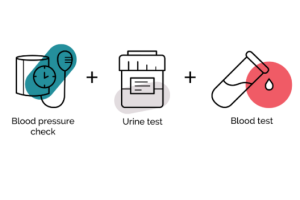
  • your blood pressure

Blood pressure measures how hard your blood is pumping through the arteries (blood vessels) in your body. The top number (systolic blood pressure) measures the pressure when your heart pumps blood out. The bottom number (diastolic blood pressure) measures the pressure when your heart fills with blood. A normal blood pressure is less than 120/80mmHg.

  • the bloods eGFR (estimated glomerular filtration rate)

Your eGFR is the best way to measure how well your kidneys are filtering your blood. eGFR is reported as a number on your blood test and roughly equals the percent of kidney function that you have left. A normal eGFR value is greater than 90 millilitres per minute (abbreviated mL/min/1.73m2).

  • your urine ACR (albumin:creatinine ratio)

Albumin is a protein that leaks into your urine if you have damage or scarring in the kidneys. A urine test measures the albumin level and is reported as an ACR result. Higher ACRs of >3 mg/mmol can be a sign of kidney disease.


Depending on your stage of kidney disease, your test result will vary. Chronic kidney disease is diagnosed when your eGFR is less than 60 mL/min/1.73m2 or you have evidence of kidney damage for more than 3 months. The stage of kidney disease depends on your eGFR level and the amount of kidney damage present.
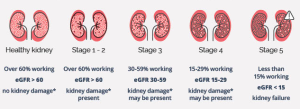
*Kidney damage is indicated by any of the following: albumin in the urine (albuminuria), blood in the urine (haematuria), or abnormal results on tests such as ultrasound or kidney biopsy.


Stages of kidney disease

You may not know you have early-stage kidney disease, as you feel completely normal. These early stages of kidney disease are usually identified by a routine Kidney Health Check. Your eGFR result is above 60 mL/min/1.73m2, meaning that your kidney function is normal or mildly decreased. To be diagnosed with Stage 1 and 2 kidney disease, you must have signs of kidney damage like:

  • blood in the urine
  • albumin in the urine
  • or abnormal kidney structures

During these stages, you’ll need to be monitored by your doctor every year for a Kidney Health Check. Positive lifestyle changes, like avoiding smoking and following a healthy diet, can help to slow the progression of kidney disease at this stage. Your doctor may start blood pressure medicines, such as ACE inhibitors or ARBs to slow the progression of your kidney disease.

At Stage 3 kidney disease, your kidneys start to lose function as your eGFR drops. You may have signs of kidney damage such as albuminuria, haematuria, or abnormal ultrasound or kidney biopsy results.

Stage 3 kidney disease is divided into Stage 3a and Stage 3b. In Stage 3a kidney disease, your eGFR is 45-59 mL/min/1.73m2.

You may start to notice symptoms of kidney disease at Stage 3b kidney disease, such as swelling, tiredness, or loss of appetite. At this stage, your kidney function is working at ~30-44%, with an eGFR of 30-44 mL/min/1.73m2.

At Stage 4 kidney disease, you’ll start to feel unwell as the waste in your body increases and your blood pressure rises. You may notice symptoms like tiredness, puffy legs or ankles, foamy or frothy urine, or a change in the number of times you pass urine. Your eGFR result will be <15-29 mL/min/1.73m2.

Even with the best management, kidney disease can sometimes lead to kidney failure, which can be life threatening. Patients with kidney failure require dialysis or a kidney transplant to stay alive. Your eGFR result will be less than 15.

During this stage, it’s normal to feel tired, sad or fearful. But with appropriate treatment, it’s still possible to continue to live a fulfilling life. Surround yourself with others that can support you, both physically and emotionally.

How to care for yourself

No matter what stage you’re at, being aware of how you feel, along with effective management, can slow the progress of kidney disease and reduce the chance of other complications.

If you’d like to know more, Kidney Health Australia is here for support. You can call our Kidney Helpline and speak to a health professional on 1800 454 363 between 9am-5pm Australian Eastern Standard Time. It’s a free call.

Kidney Health 4 Life

Ready to take control of your kidney health? See what each stage means and the actions to take with Kidney Health 4 Life.

cta

Last updated: November 2025