
Peritoneal dialysis

Peritoneal dialysis can offer flexibility of undergoing treatment at home, and with less intense sessions. Learn more to see if it's right for you.

Understanding Peritoneal Dialysis for Kidney Failure

Peritoneal dialysis is a treatment option for kidney failure. After being trained by your healthcare team, you can undergo this method at home, providing you with additional comfort during your treatments.

There are two different types of peritoneal dialysis – Continuous Ambulatory Peritoneal Dialysis (CAPD) and Automated Peritoneal Dialysis (APD), to suit different lifestyles and preferences
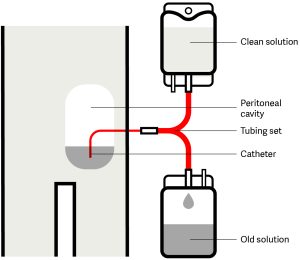

Peritoneal dialysis

CAPD, often referred to as ‘day bags’, is a method that usually involves doing four exchanges each day (each lasting 30 minutes). During these exchanges, you’ll insert a special peritoneal catheter which will transfer dialysis fluid in and out of your peritoneal cavity, cleaning our blood.

You can do you CAPD exchanges pretty much anywhere. In between each exchange you’re free to go about your daily activities, as per usual. You’ll usually undergo your exchanges when you first wake up, at lunch time, at dinner time and before bed. However, you can change it around to meet your schedule on busy days.

APD involves being hooked up to a machine called a cycler overnight, which automatically does exchanges for your. Before going to bed, you’ll hook your peritoneal catheter to the tubing of the cycler, and it’ll get to work while you’re asleep.

APD must be done every night, typically taking eight to ten hours.

Some of the benefits of peritoneal dialysis compared to haemodialysis include:

  • with a little bit of organisation, you have more freedom to travel
  • you can do your dialysis in the comfort of your own home
  • you have more control over your lifestyle
  • dialysis at night makes it easier to fit in around family and work commitments
  • it’s a straightforward technique that most people can learn in a week
  • it’s a gentle form of dialysis
  • most people have no diet restrictions, and very few fluid restrictions

Since you’ll be undergoing peritoneal dialysis at home, you’ll need to be trained to do it on your own. A specialised nurse at our renal unit will be able to train you, which will usually take about one week. You can also bring along a support person or family member to undertake the training with you, so they can assist you later on.

During the training you’ll learn to:

  • perform the exchanges
  • care for your exit site
  • manage your general health
  • manage any problems with the dialysis
  • order and look after your supplies.

For more information about your training, have a chat with your renal unit team.

Whatever treatment you choose, it’s your decision. Visit My Kidneys, My Choice, an interactive tool developed to help you explore your options. You can also read a PDF version of My Kidney, My Choice online.

We're here to help

Our free Kidney Helpline is here to help you with questions about your treatment and help connect you to services.

cta

Learn more about living with kidney disease

Get access to factsheets, books and more in our resource library.